Culture is the total way of life…

ÀsÀNigHT WorldwideÀsÀNigHTWorldwide
Ọbàtálá

Ọbàtálá

Lord of the White Cloth, Creation, Wisdom & Human Dignity

White

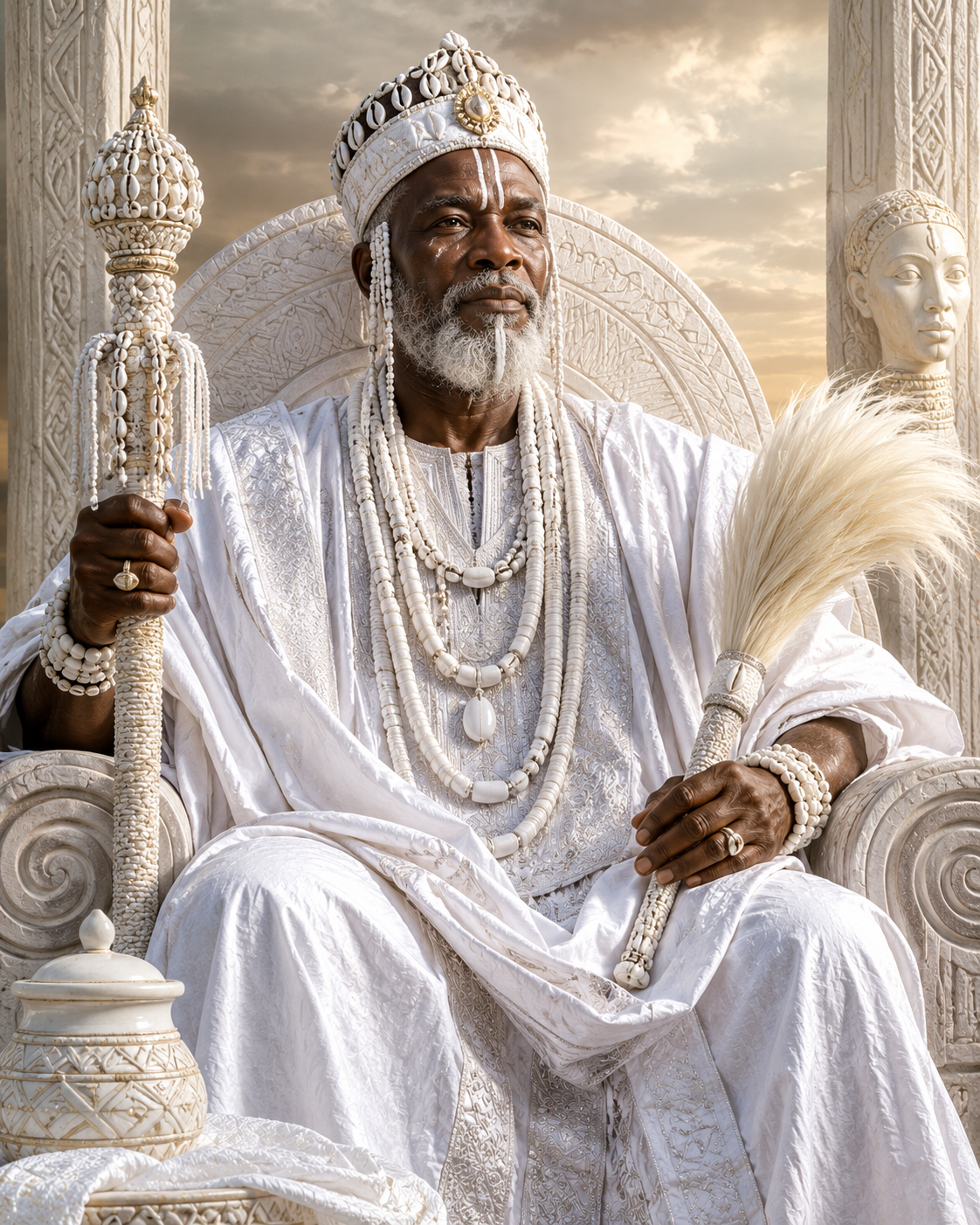
Ọ̀bàtálá is the Great Òrìṣà — the divine sculptor of humanity, robed in white, whose authority flows not from thunder or iron but from wisdom, patience, purity, and good character. His is the great Yorùbá meditation on what it truly means to be human.

Who Is Ọ̀bàtálá?

Ọ̀bàtálá is one of the most revered Òrìṣà in Yorùbá religious and cultural tradition — associated with creation, human form, wisdom, purity, patience, peace, ethical character, clear thinking, compassion, dignity, and the ordering of human existence. He occupies an elevated position, often titled Òrìṣàńlá, the 'Great Òrìṣà.'

He is widely known as the Lord of the White Cloth, and white is central to his visual and spiritual identity — representing purity, calmness, clarity, restraint, cleanliness, and elevated character. But he is far more than 'the god of purity'; his story reaches into one of humanity's oldest questions: how did human beings come to possess form, consciousness, character, and destiny?
Ọ̀bàtálá & Creation

A major body of tradition gives Ọ̀bàtálá responsibility for fashioning the terrestrial realm and shaping human beings, while the Supreme Being, Olódùmarè, provides the vital force that makes life possible. Ọ̀bàtálá shapes; Olódùmarè gives life. The body is formed, life is animated, and human existence emerges.

This creates a profound distinction between form and life force — and it places human beings at the very centre of his cultural symbolism.

The Clay of Humanity

One of the most enduring images associated with Ọ̀bàtálá is clay. Clay is soft, mouldable, and can become almost anything in the hands of a skilled sculptor — a powerful metaphor for humanity. The human body is not something that simply appears; it is formed, shaped, given structure, and made a vessel for life.

Traditions therefore associate him with the moulding of human bodies and give him the title Alámọ̀rere, working with excellent clay. He is, metaphorically, the divine sculptor of humanity: form matters, character matters, and creation requires patience.

Human Dignity

If Ọ̀bàtálá forms humanity, then human beings occupy a special position within his symbolism. The human body is not disposable; the human person is not worthless; every human being deserves dignity. This makes his tradition profoundly relevant to modern conversations about human rights, disability, compassion, equality, and ethical leadership.

Traditional stories have sometimes been used to explain physical differences among people. ÀsÀNigHT Worldwide preserves this as cultural heritage — not as modern medical explanation — and reads it through a positive ethical principle: human variation does not make one person more human than another.

The White Cloth

His most recognisable symbol is white cloth — so central that white becomes almost inseparable from his identity. Historical and museum sources describe white as sacred to him, associating his temples, ritual objects, white beads, and devotees with the colour.

White is not merely an aesthetic preference; it communicates a way of living. It can symbolise purity, clarity, peace, cleanliness, calmness, truth, simplicity, self-control, and good character. To wear white symbolically is to say: I seek clarity, peace, cleanliness of character, restraint, and truth.

Calmness & Patience as Power

Ọ̀bàtálá's power differs from Ṣàngó's thunder or Ògún's iron. His authority is expressed through wisdom, patience, calmness, judgment, clarity, and self-control — teaching that not every powerful person needs to be loud. A person who stays calm while others rage possesses a form of power.

This connects to ìwà pẹ̀lẹ́ — gentle, good character. Patience is not weakness; it is controlled strength. The person with wisdom knows when to speak, the person with patience knows when to wait, and the person with dignity knows when to walk away.

Ìwà — Character Before Status

The Yorùbá concept of ìwà is deeply tied to character and the quality of one's being. A central lesson of Ọ̀bàtálá is that a person's character matters more than outward appearance. One may possess wealth, beauty, power, or education — but without good character, those things can become dangerous.

He therefore becomes a powerful symbol of character before status. The beautiful body, the intelligent mind, and the wealthy household are all valuable — but character determines how those gifts are used.

Wisdom, Justice & Peace

Wisdom differs from intelligence. Intelligence helps solve a problem; wisdom helps you understand whether it should be solved at all. Research on the Ọ̀bàtálá community in Ilé-Ifẹ̀ describes him as an embodiment of justice, purity, clear thinking, wisdom, cleanliness, and calmness.

Justice here is not simply punishment — it is fairness, truth, balance, restraint, and good judgment. A just person does not let anger determine the verdict. And peace, in his tradition, is not the absence of conflict but the presence of self-control, dialogue, compassion, and understanding. A peaceful person is not a weak person.

Self-Control, Moderation & the Palm Wine

Some Ifá literary traditions portray Ọ̀bàtálá as rejecting excessive material pleasure in favour of simplicity, restraint, and moderation. The message is sophisticated: having access to something does not mean you must consume it. You can possess wealth without greed, power without arrogance, pleasure without being controlled by it.

A widely transmitted narrative tells of Ọ̀bàtálá becoming intoxicated by palm wine before completing an important assignment. This should not be treated as the single universal creation account, but its moral is powerful: even great wisdom can be undermined by a loss of self-control.

Ọ̀bàtálá & Odùduwà

The relationship between Ọ̀bàtálá and Odùduwà is one of the most important — and sometimes contested — subjects in Yorùbá tradition. Some narratives present them as complementary; others emphasise conflict; still others place different weight on their roles in the origins of Ilé-Ifẹ̀.

Scholarly work shows that multiple versions exist through oral transmission. ÀsÀNigHT Worldwide therefore avoids presenting any single version as unquestionable historical truth — the variation is evidence of a living oral tradition, not a flaw within it.

Ilé-Ifẹ̀ & Living Tradition

Ọ̀bàtálá traditions are deeply rooted in Ilé-Ifẹ̀, one of the most important sacred and historical centres of Yorùbá civilisation. A contemporary study of the Ọ̀bàtálá religious community there documents continued worship, sacred spaces, white clothing, cleanliness practices, vigils, ritual leadership, and observance of the traditional five-day Yorùbá week.

This shows that Ọ̀bàtálá is not merely preserved in old mythology — he remains part of living Yorùbá religious culture, continuing in shrines, palaces, festivals, families, songs, language, and community identity.

Cleanliness as Moral Language

Cleanliness is strongly associated with Ọ̀bàtálá — and not merely the physical kind. It also means clean intentions, clean speech, clean conduct, clean relationships, and a clean conscience. A clean garment becomes a metaphor for a clean character; a clean environment becomes a metaphor for a disciplined life.

In this way, white functions as a moral language: it communicates restraint, clarity, dignity, and peace. White becomes more than a colour — it becomes an ethical statement.

In the African Diaspora — Oxalá

Ọ̀bàtálá's tradition travelled across the Atlantic during the forced migration of Africans. In Brazil he became Oxalá, one of the most prominent Orixás in Candomblé, where white symbolism remained deeply important. Related traditions also developed in Cuba and across the Caribbean.

Across the ocean, Ọ̀bàtálá became Oxalá while retaining creation, whiteness, peace, purity, elderhood, wisdom, and spiritual authority. His survival — through displacement, suppressed languages, and separated families — is an extraordinary story of cultural continuity and African resilience.

Join the Community

Preserving Heritage. Sharing Knowledge.

Receive new articles, festival stories, and cultural insights from ÀsÀNigHT Worldwide — delivered with care, rooted in authenticity.