Culture is the total way of life…

ÀsÀNigHT WorldwideÀsÀNigHTWorldwide
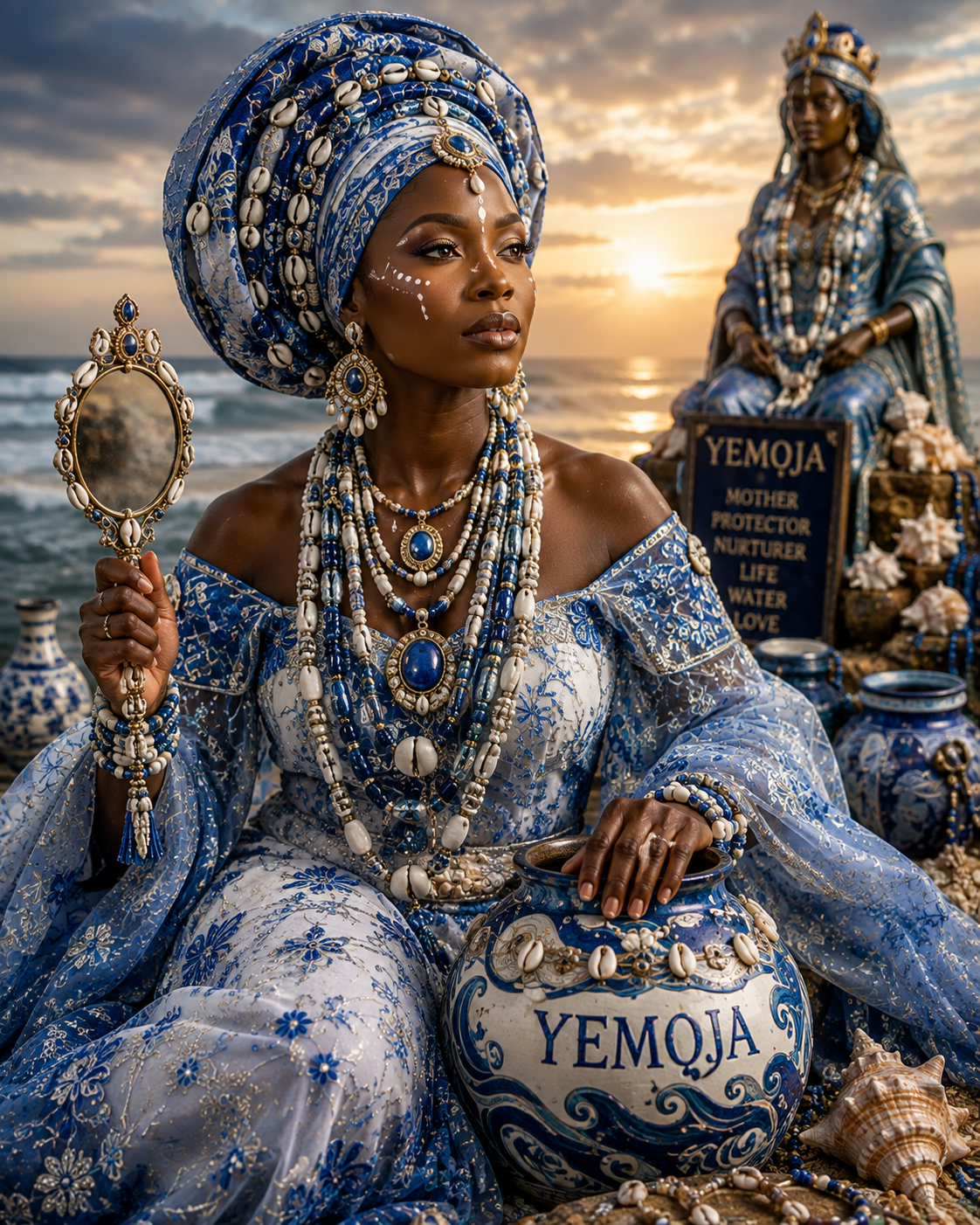
Yemọja

Yemọja

The Divine Mother, Guardian of Water, Motherhood, Protection & Life

Blue & White

Yemọja is the mother whose embrace is as vast as the waters — guardian of rivers and oceans, of women and children, of life itself. Hers is the great Yorùbá teaching that the source which nourishes us must, in turn, be protected.

Who Is Yemọja?

Yemọja is one of the most important female Òrìṣà in Yorùbá tradition. Her name is commonly understood as 'Mother of Fish' — an expansive image of motherhood whose children are beyond counting, as numerous as the fish and as vast as the waters. She is associated with motherhood, water, fertility, protection, nurturing, women, children, creation, healing, emotional strength, family, and the mysterious depth of the waters.

In Yorùbáland she is especially associated with rivers, streams, springs, and fresh water — particularly the Ògùn River — while across the Atlantic Diaspora she became strongly associated with the ocean. She is the mother whose embrace is as vast as the waters.
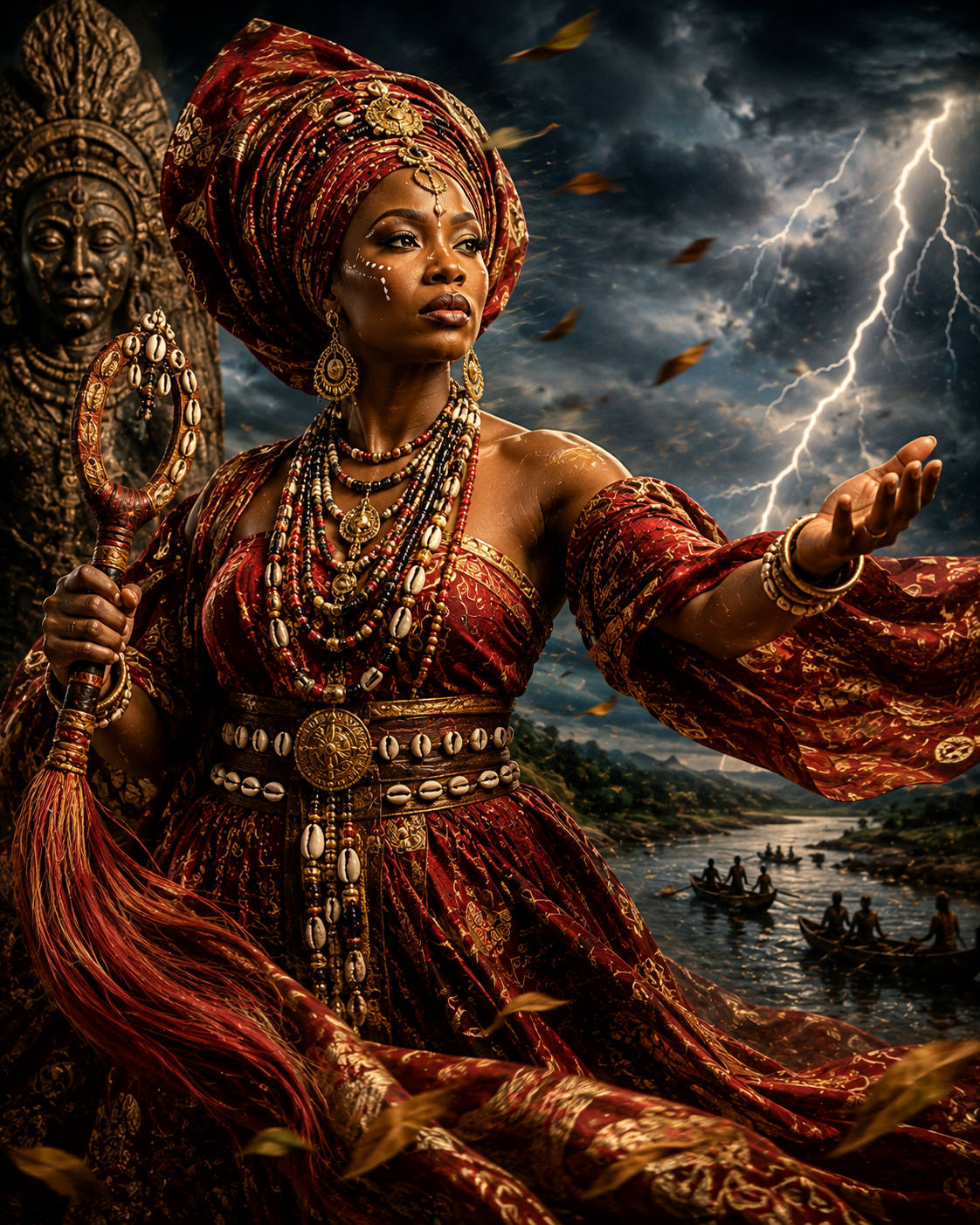
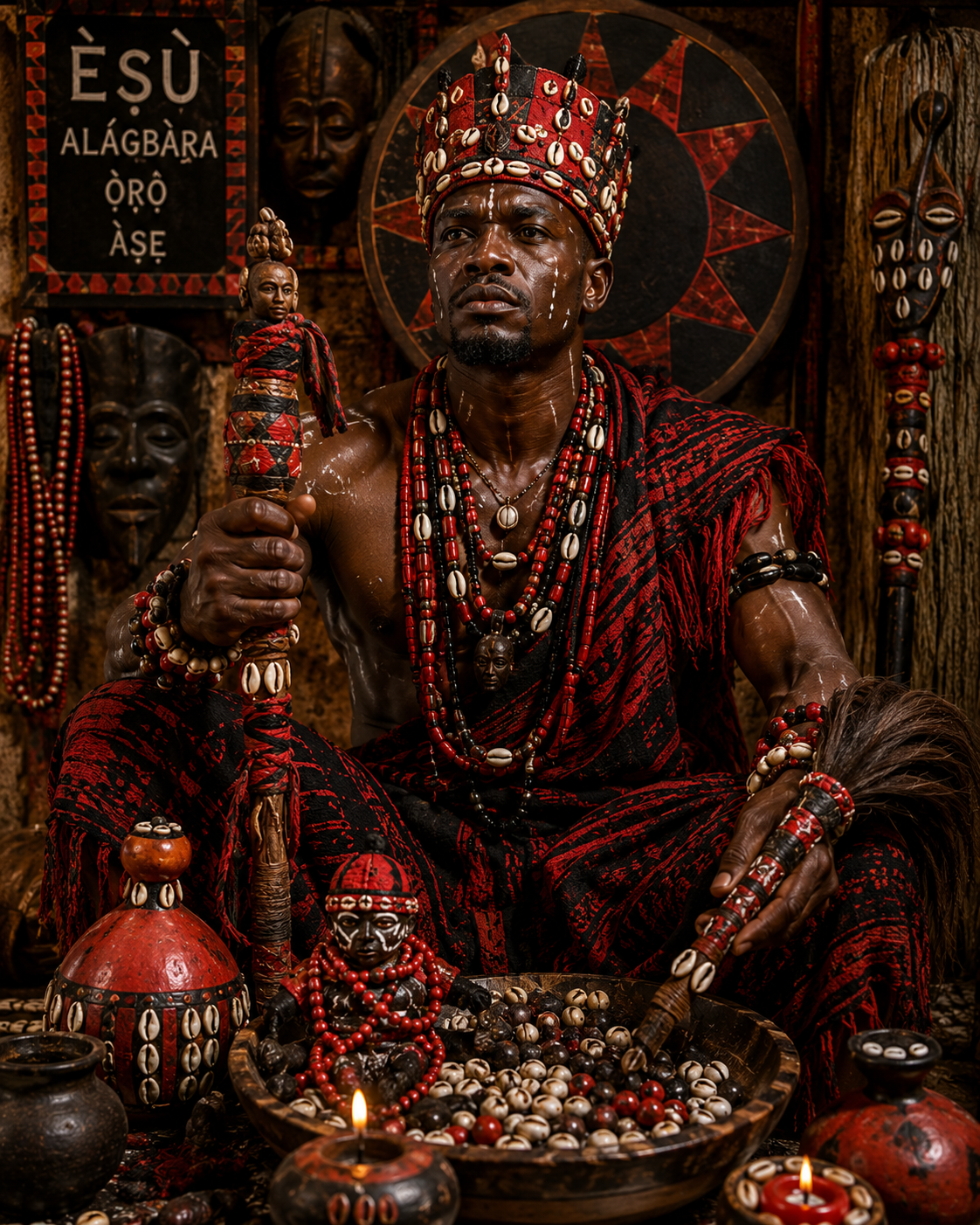
Yemọja in Yorùbáland

An important distinction: Yemọja in Yorùbáland is not simply identical to the oceanic Yemayá of the Caribbean or Iemanjá of Brazil. In many Yorùbá traditions she is closely associated with freshwater rivers, especially the Ògùn River, whose movement represents life, fertility, nourishment, connection, and continuity.

Abeokuta, in present-day Ogun State, is one of the important centres of her worship, where devotees still gather at her river shrine to pray, sing, and present offerings. Yemọja is not merely a figure from an ancient story — she remains part of a living tradition.

Water Is Life

Water is one of humanity's most fundamental needs: without it, people cannot survive, crops cannot grow, animals cannot thrive, and communities cannot develop. Yemọja's association with water places her at the centre of a profound philosophical idea — water is life itself.

This gives her tradition urgent modern relevance. If water is sacred, then contaminating it becomes more than an environmental crime; it becomes a cultural violation. Rivers, wetlands, springs, and marine ecosystems all need protection — and protecting water is protecting future generations.

The Divine Mother

Motherhood is the most powerful dimension of Yemọja. A mother nurtures, protects, feeds, teaches, comforts, disciplines, sacrifices, and guides. She is not simply a symbol of biological motherhood but of the very principle of nurturing life. In many traditions she is described as a mother to other Òrìṣà — though the exact family relationships vary widely, for there is no single universal Òrìṣà family tree.

Water surrounds, a mother's arms surround, the womb surrounds, the ocean surrounds. Yemọja is the image of the protective embrace — the water that says: you are held, you are surrounded, you belong.

Yemọja Is Not Weak

Motherhood is sometimes portrayed as passive; Yemọja challenges that idea. A mother can be gentle and fierce, compassionate and protective, patient and unyielding when necessary. A calm river can become a flood; the ocean can be peaceful one moment and formidable the next. She represents both nurturing power and formidable power.

Water looks soft, yet over time it carves valleys, reshapes landscapes, erodes stone, and moves enormous objects. Her symbolism teaches that gentleness and strength can exist together — and that beneath a mother's calm surface can lie enormous strength, sacrifice, memory, and emotion.

Emotional Depth, Healing & Forgiveness

Water is the great metaphor for emotion: tears are water, grief flows, love flows, memory flows. Yemọja's waters are an image of emotional depth, reminding us that emotions are not weaknesses but part of being human. Water also cleanses, refreshes, and restores, connecting her with renewal, comfort, and healing — cultural and spiritual associations, not substitutes for modern medical care.

Water washes away, creating a symbolic link between water and forgiveness. Forgiveness does not mean pretending harm never happened; it can mean refusing to let yesterday's pain control tomorrow. Her waters become a metaphor for emotional renewal.

Women, Family & Community

Yemọja is strongly connected with pregnancy, motherhood, children, fertility, family, and protection — a powerful cultural image of feminine strength. Pregnancy is one of life's most extraordinary transformations, and children represent the future; a society's treatment of its children reveals its values. Protection means more than safety: children need education, love, culture, identity, guidance, and community.

Motherhood extends beyond the family. A community can behave like a mother — feeding, protecting, educating, guiding, and preserving culture. And because a mother teaches her children, Yemọja connects motherhood with cultural transmission: how stories, names, songs, rituals, and languages survive across generations.

Feminine Power & Leadership

Yemọja offers a model of feminine authority that does not depend on domination — power that emerges through nurturing, protection, wisdom, emotional strength, creation, and community. Leadership is not always about commanding people; sometimes it means protecting them, creating opportunity, maintaining unity, raising the next generation, and preserving cultural memory.

Her maternal power is also creative power. Creation does not only mean childbirth — an artist creates, a writer creates, a teacher creates future possibilities. Yemọja symbolises the creative power to bring something new into existence.

From River to Ocean — the Middle Passage

One of the most important transformations in her history is the shift from river to ocean. Imagine enslaved Africans transported across the Atlantic, taken from their homes, families, languages, land, and rivers. The ocean became the terrifying boundary between home and exile — yet the traditions of water survived, and Yemọja could now be encountered across the sea.

This carries painful memory: for many descendants the ocean is associated with loss, death, and separation. Yet it also became the place where African spiritual traditions continued to live — a profound paradox in which the same ocean that carried unimaginable suffering also became a carrier of cultural survival.

Yemọja in the African Diaspora

Yemọja became one of the most widely recognised Òrìṣà in the Americas — Yemayá in Cuba, strongly tied to the sea, motherhood, protection, and feminine power within Lukumí/Santería; and Iemanjá in Brazil, deeply woven into cultural life, honoured with white and blue clothing, shells, flowers, candles, and boats sent out to the sea. These traditions are distinct from Yorùbáland Ìṣẹ̀ṣe even as they share ancestry.

In the diaspora she also became associated with the moon, whose pull moves the tides — a beautiful link between moon, water, femininity, cycles, and change. Common modern colours of blue and white evoke water, sky, depth, purity, and maternal tenderness, though such conventions vary by lineage.

Among the Water Òrìṣà

Yemọja should not be collapsed into every other water Òrìṣà. She differs from Ọ̀ṣun (the Ọ̀ṣun River, sweetness, love, beauty, diplomacy), from Olókun (the sea and its immense depths), and from Yemọ̀wó (a distinct figure associated with Ilé-Ifẹ̀ and Ọ̀bàtálá traditions). Similar names and overlapping water symbolism do not make these Òrìṣà identical.

Her maternal symbolism reaches across many sacred narratives: some traditions describe Ògún or Ṣàngó as her children, others preserve different relationships. Yorùbáland holds many water traditions rather than one generic 'water goddess,' and ÀsÀNigHT Worldwide preserves these variations rather than presenting one community's account as universal.

A Bridge of Memory & Identity

For African descendants outside Africa, Yemọja can represent a connection to ancestral memory. The ocean may have separated ancestors from Africa, but the spiritual tradition crossed that ocean — so she becomes a symbol of ancestry, survival, memory, identity, and connection for those who may not know their village, lineage, or original language.

Her survival across continents — through enslavement, colonialism, religious suppression, and language loss — is extraordinary. She emerged in different forms and by different names, but the mother remained. Perhaps her deepest lesson is this: you may cross the ocean, but you do not have to lose your source.

Join the Community

Preserving Heritage. Sharing Knowledge.

Receive new articles, festival stories, and cultural insights from ÀsÀNigHT Worldwide — delivered with care, rooted in authenticity.