Culture is the total way of life…

ÀsÀNigHT WorldwideÀsÀNigHTWorldwide
Ọ̀rúnmìlà

Ọ̀rúnmìlà

Witness of Destiny, Keeper of Wisdom & Voice of Ifá

Green & Yellow

Ọ̀rúnmìlà stands at the centre of Ifá — one of Africa's greatest intellectual and spiritual traditions: a mathematics, a literature, a philosophy, and an ethic of wise decision-making, all carried in living human memory across the centuries.

Who Is Ọ̀rúnmìlà?

Ọ̀rúnmìlà is one of the most important figures in Yorùbá religious philosophy — the Òrìṣà associated with wisdom, knowledge, divination, destiny, intellectual development, moral reasoning, healing, and the interpretation of the mysteries of existence. UNESCO describes him, also called Ifá, as the Yorùbá deity of wisdom and intellectual development.

But he is far more than a figure who 'tells the future.' At its deepest level, his tradition concerns one of humanity's most important questions: how can human beings make wise decisions in an uncertain world?
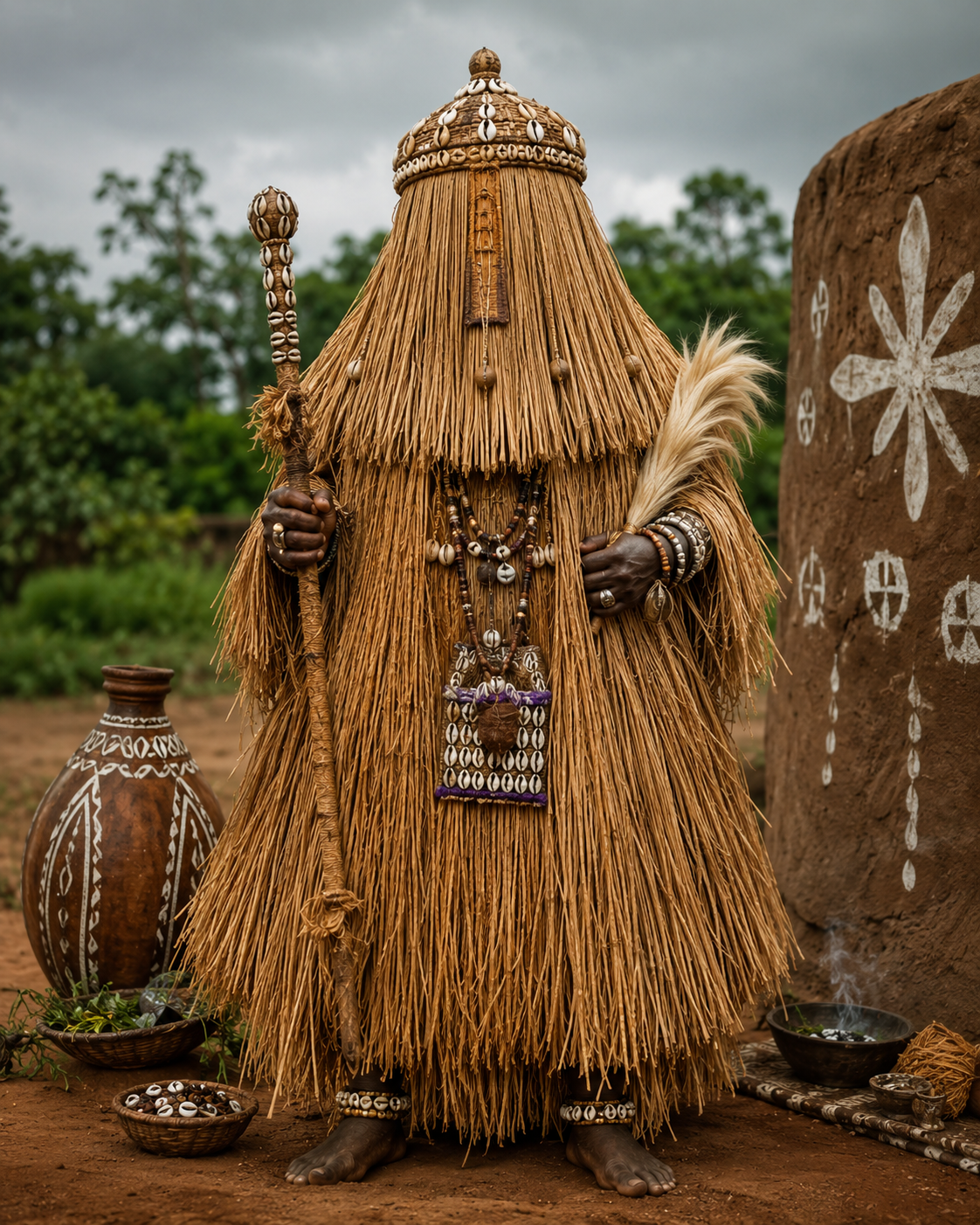
Ọ̀rúnmìlà & Ifá

An essential distinction: Ọ̀rúnmìlà is the divine figure, while Ifá is the body and system of knowledge associated with him. In practice the two are deeply intertwined, and 'Ifá' can refer to the sacred power, the mystical figure, or the divination system itself.

Ifá is simultaneously a divination system, an oral literary tradition, a philosophical system, a repository of history, a body of ethical teachings, a method of decision-making, a body of sacred poetry, and a living cultural institution. To translate 'Ifá' merely as 'fortune-telling' misses almost all of its meaning.

Not Simple Fortune-Telling

In popular imagination, divination means predicting tomorrow. Ifá is far more complex. A person comes with a concern; the process produces a pattern; the diviner identifies an Odù; the appropriate verses are recalled — offering narratives, warnings, principles, possibilities, and recommended conduct.

The purpose is not merely 'this is what will happen,' but rather: 'here is the pattern surrounding your situation, here is what wisdom teaches about it, here are the consequences of different choices, and here is how you should conduct yourself.' This is why Ifá carries such a strong ethical dimension.

The 256 Odù & the Mathematics of Ifá

One of Ifá's most remarkable features is its system of 256 Odù, generated from combinations of fundamental binary signs. These form the structural framework through which the vast literary corpus is organised, combining pattern, mathematics, memory, language, poetry, philosophy, and interpretation.

This binary, combinatorial structure makes Ifá an extraordinary example of an indigenous African intellectual system — mathematical structure coexisting with oral literature and philosophical interpretation. UNESCO explicitly describes it as using a vast corpus of texts and mathematical formulas.

The Babaláwo & the Ìyáláwo

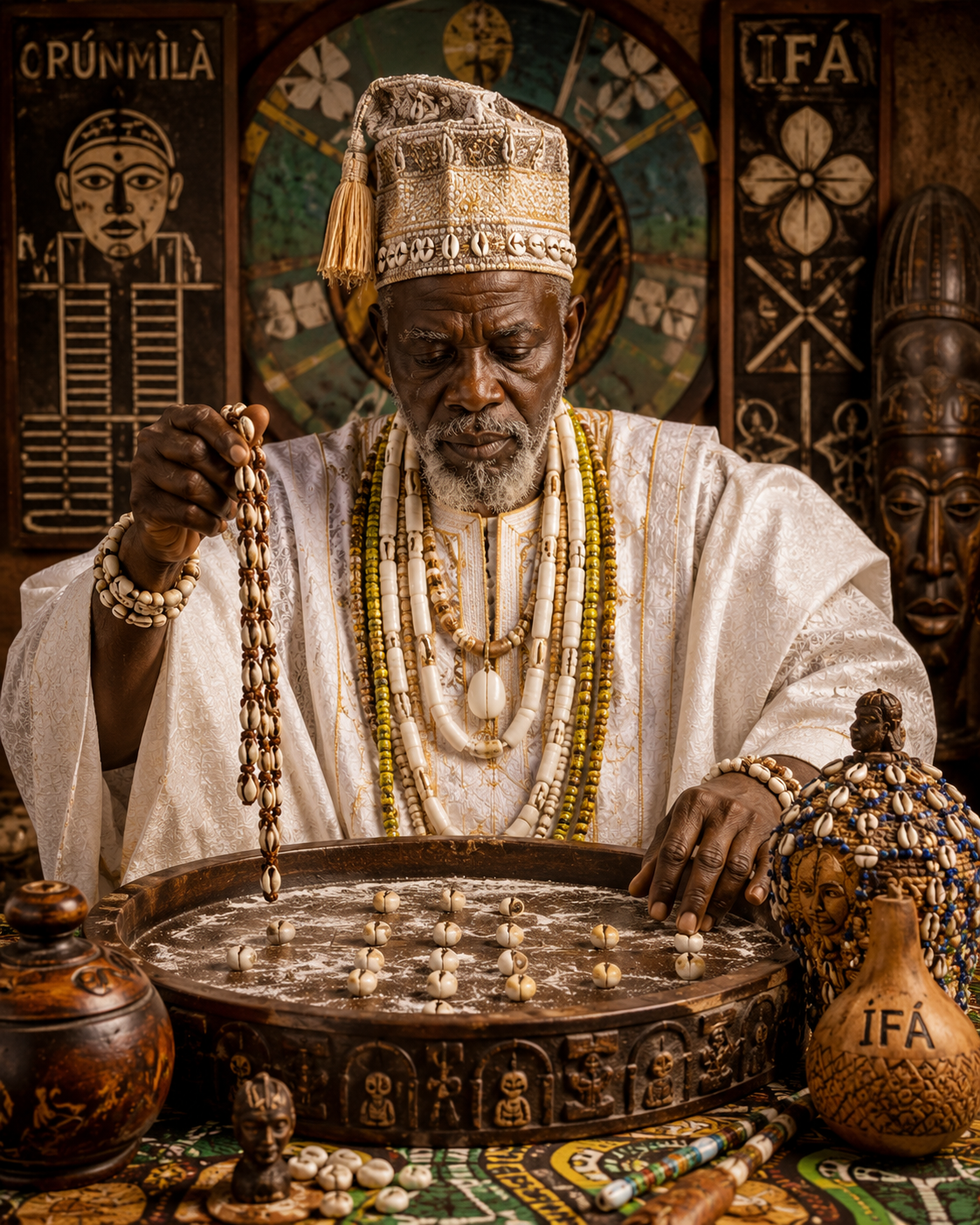
The Babaláwo — 'father of secrets' — is an initiated Ifá priest and diviner who interprets the system of signs. The role demands enormous memorisation: Odù, ẹsẹ̀ Ifá, proverbs, myths, history, ritual and interpretive knowledge, and in some lineages botanical medicine. The corpus continues to grow, with hundreds of verses for each Odù.

Women are also initiated into Ifá in some traditions and may be known as Ìyáláwo. Their roles have varied across time, community, and region — so the claim that 'Ifá belongs only to men' does not represent the true complexity of the tradition.

A Library Without Walls

Imagine a library with no building, no shelves, no printed volumes — thousands of verses stored inside human memory. The Babaláwo carries the library; the teacher passes it to the student; the student becomes a teacher. Generation after generation, the knowledge survives.

The sacred instruments — the ikin (palm nuts), the ọ̀pẹ̀lẹ̀ (divining chain), the ọ̀pọ́n Ifá (carved tray), and ìyẹ̀ròsùn (divination powder) — form the material culture through which this living archive is consulted.

The Witness of Destiny & Orí

A central tradition holds that Ọ̀rúnmìlà was present in the heavenly realm when human beings chose their destiny — so he possesses knowledge of the paths people are attempting to follow, and can serve as a divine counsellor who knows what humans often forget.

This connects him to Orí — literally 'head,' but in Yorùbá philosophy the inner consciousness, personal destiny, spiritual identity, and capacity for self-realisation. Orí belongs to a broader system and should not simply be described as 'created by Ọ̀rúnmìlà'; the deeper point is his tradition's immense emphasis on the human person.

Destiny Is Not Passivity

A common misunderstanding is that belief in destiny means humans have no freedom. Ifá teaches the opposite: it repeatedly emphasises human conduct. People make choices; choices have consequences; character, effort, wisdom, relationships, and ethical behaviour all matter.

Destiny does not simply teach 'everything is decided, so nothing matters.' If your behaviour matters, then your choices matter; if choices matter, character matters; if character matters, wisdom matters. Destiny and responsibility exist together — Ọ̀rúnmìlà is the counsellor at the crossroads of uncertainty.

Wisdom, Character & Ìwà Pẹ̀lẹ́

Wisdom is not simply knowing many facts. It means knowing which knowledge matters, when it matters, how to apply it, and what consequences it may produce — knowing when to speak and when to remain silent, when to act and when to wait.

Ifá's ethical worldview returns constantly to ìwà pẹ̀lẹ́, gentle and refined character. Success without character is fragile and even dangerous. Ọ̀rúnmìlà therefore represents wisdom with character: be truthful, patient, keep promises, respect others, avoid arrogance, and never let greed or anger take control.

Ifá as Cultural Archive & Oral Literature

The ẹsẹ̀ Ifá preserve poetry, proverbs, myths, historical memories, ethical teachings, social commentary, and philosophical argument — reflecting how generations understood marriage, family, politics, work, trade, medicine, morality, and human relationships. UNESCO recognises Ifá as preserving Yorùbá history, language, beliefs, worldview, and social concerns.

When an Ifá verse disappears, more than a religious text is lost: a proverb, a historical memory, an old linguistic expression, and a worldview can vanish with it. Transmitting Ifá is therefore an act of cultural preservation — and UNESCO has noted concern about the ageing of many priests and the challenge of passing this complex knowledge to the young.

Relationships: Èṣù, Ọ̀sányìn & Olódùmarè

Ọ̀rúnmìlà represents knowledge and interpretation; Èṣù represents the dynamic movement through which choices become consequences — a profound pairing: knowledge tells you what to understand, choice determines what you do with it. His bond with Ọ̀sányìn, keeper of leaves and herbal knowledge, links Ifá to healing and ecological wisdom.

Importantly, Ọ̀rúnmìlà is not the Supreme Being. In Yorùbá cosmology Olódùmarè occupies the supreme position, while Ọ̀rúnmìlà is the Òrìṣà associated with wisdom and Ifá — which is why describing him simply as 'God' is inaccurate.

African Intellectual Heritage

For centuries African intellectual traditions were dismissed through assumptions that treated Africa as a place without sophisticated systems of philosophy and knowledge. Ifá challenges that assumption directly — containing mathematical structures, complex oral literature, ethical philosophy, historical memory, linguistic knowledge, and pattern interpretation.

Ọ̀rúnmìlà can be approached as a symbol of the African philosopher, asking: What is knowledge? What is destiny? What is good character? What makes a life successful? How should humans respond to uncertainty and live with one another? These are enduring philosophical questions.

Survival & the Diaspora

Ọ̀rúnmìlà's tradition survived colonialism, religious discrimination, and forced migration. It crossed the Atlantic into the Caribbean and the Americas, where Ifá continues to be practised today, connected to Yorùbá heritage yet developing within its own communities.

In 2008 UNESCO inscribed the Ifá divination system on the Representative List of the Intangible Cultural Heritage of Humanity, recognising its continuing cultural significance — a testament to one of Africa's most remarkable intellectual and religious traditions.

Join the Community

Preserving Heritage. Sharing Knowledge.

Receive new articles, festival stories, and cultural insights from ÀsÀNigHT Worldwide — delivered with care, rooted in authenticity.