Culture is the total way of life…

ÀsÀNigHT WorldwideÀsÀNigHTWorldwide
Ọbalúayé

Ọbalúayé

Lord of the Earth, Disease, Healing & Renewal

Earth tones

Ọ̀balúayé stands at the intersection of earth and humanity, illness and healing, fear and compassion, suffering and renewal. His is the great Yorùbá story of how a people transformed the fear of disease into a framework for responsibility, dignity, community protection, and hope.

Who Is Ọ̀balúayé?

Ọ̀balúayé is one of the major Òrìṣà of Yorùbá religious and cultural tradition — associated with the earth, disease, epidemics, healing, protection, vulnerability, suffering, recovery, and the forces that govern human health and survival. He is historically linked with smallpox, one of the most devastating epidemic diseases known to earlier societies.

But he is not simply a deity of sickness. The same spiritual power associated with illness is also associated with healing and protection from illness. This apparent contradiction is central to understanding him: the force that threatens life is also connected to the power of preserving it.
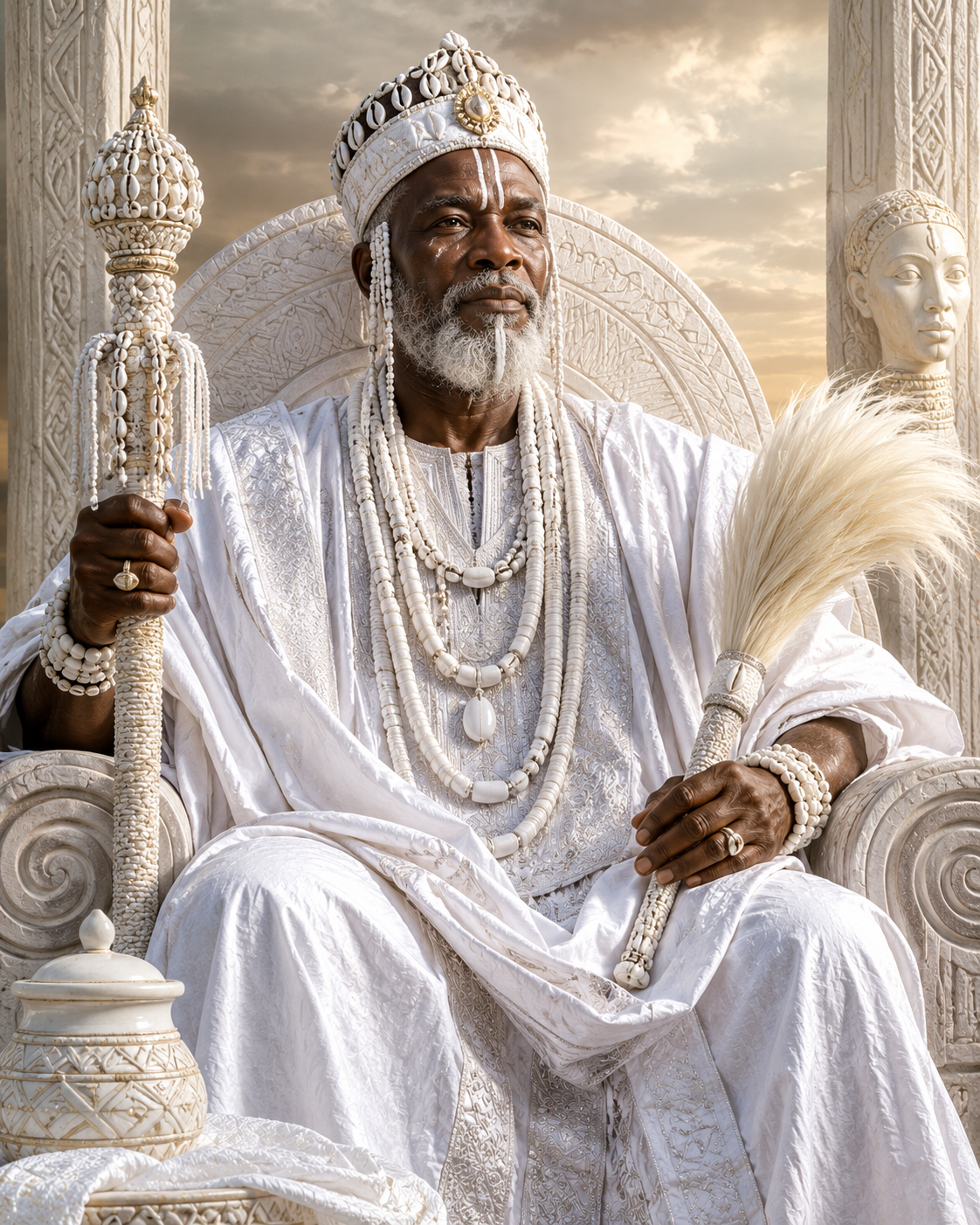
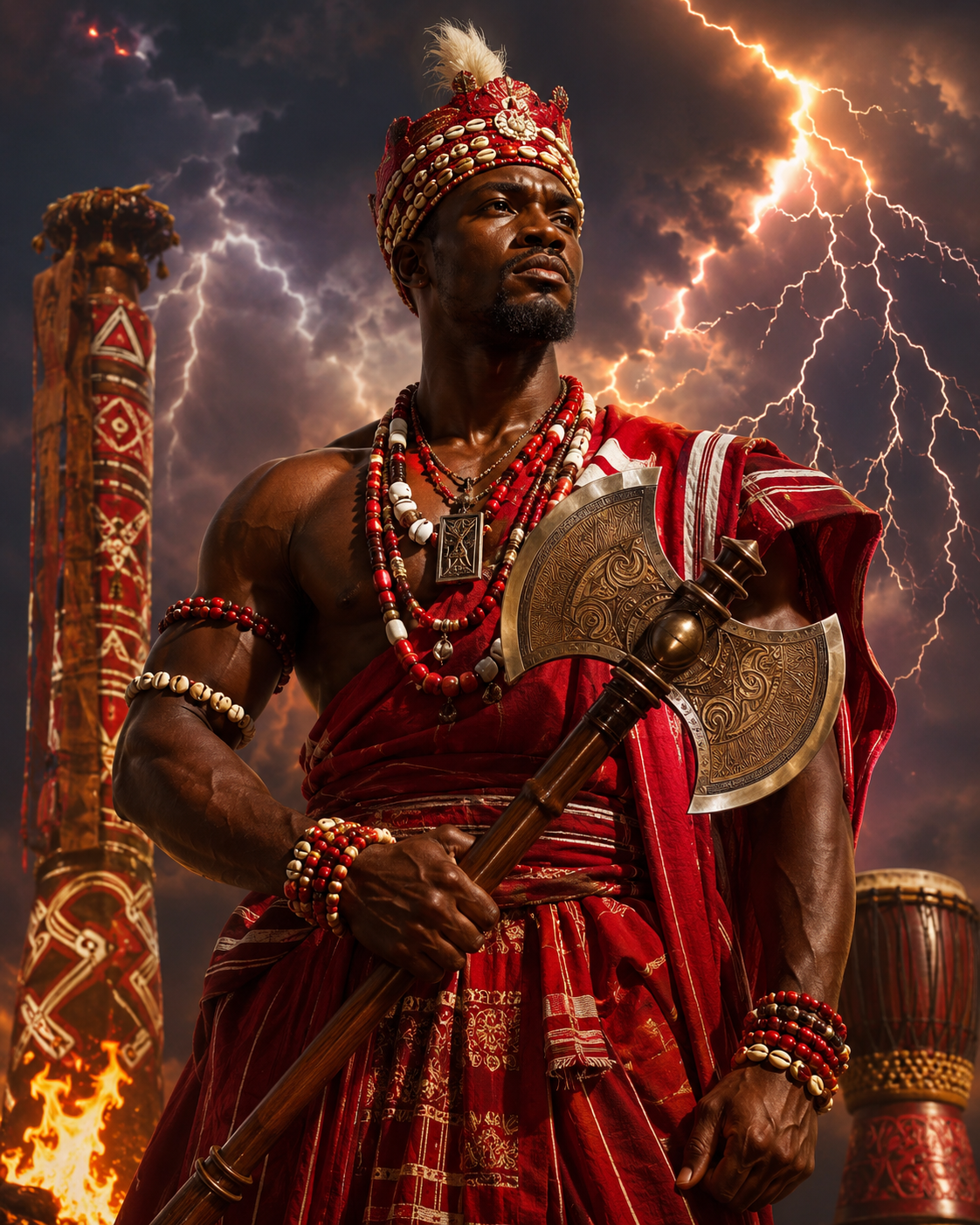
Lord of the Earth

The name is commonly interpreted from Yorùbá elements — Ọba (king), Olú (lord/master), and ayé (the world or earth) — producing an understanding along the lines of 'King who rules the world.' Scholarly discussion likewise identifies him as an earth deity whose authority extends over the ground upon which people live, build, cultivate, and walk.

We walk upon the earth. We build upon it. We cultivate it. We bury our dead within it. We receive food from it. And we return to it. Ọ̀balúayé is therefore bound to one of the oldest realities of human existence: our complete dependence upon the earth, which provides, sustains, and eventually receives the body.

The Earth as Provider

The earth provides crops, roots, grains, medicinal plants, and the materials for homes and tools. Traditional accounts associate Ṣọ̀pọ̀nná with the grains of the earth and the nourishment that comes from it, while also recognising his power to afflict.

This creates a profound duality: the same earth that feeds humanity can also remind humanity of its vulnerability. The earth is neither simply good nor simply dangerous — it is powerful, and human beings depend upon it.

Ṣọ̀pọ̀nná & the Reality of Epidemics

Historically, smallpox was among the most feared infectious diseases in West Africa. It could spread rapidly and kill people of every social class. Before modern epidemiology, communities needed explanations for outbreaks and systems for responding to them — and within Yorùbá religious thought smallpox became strongly associated with Ṣọ̀pọ̀nná.

An outbreak was never an isolated event. It reshaped families, markets, travel, burial practices, and the entire social structure of a community. An Òrìṣà associated with epidemic disease therefore became, of necessity, an Òrìṣà of community survival.

Priests, Knowledge & Traditional Inoculation

One of the most fascinating aspects of the tradition is that Ṣọ̀pọ̀nná priests were not merely ritual specialists. Historical scholarship documents them participating in smallpox prevention, treatment, the burial of victims, and even inoculation — demonstrating that traditional religious institutions could also function as systems of community health management.

This historical inoculation must be distinguished from modern vaccination, which rests on scientifically developed immunological methods. Yet its existence shows that traditional societies were actively developing approaches to managing epidemic disease long before modern public-health systems existed.

Colonial History — Beyond the Stereotype

During the colonial period British authorities became deeply concerned about smallpox and about the influence of Ṣọ̀pọ̀nná priests, eventually prohibiting the cult's practices in south-western Nigeria in the early twentieth century. The encounter between African traditional religion and Western medicine was never a simple story of 'science versus superstition.'

Older colonial accounts sometimes portrayed the priests as deliberately spreading smallpox. Modern scholarship treats these claims critically, noting that the priests often possessed substantial practical knowledge. ÀsÀNigHT Worldwide studies these institutions historically rather than caricaturing them.

The Healer of the Afflicted

The most important paradox of Ọ̀balúayé is that he is associated with both disease and healing. Within the traditional worldview this is not a contradiction: the power responsible for a dangerous force can also be approached for protection from it. He is connected with illness, healing, protection, recovery, cleansing, and survival.

Disease can isolate people; visible illness can produce stigma; the sick can be treated as though they are somehow less human. His tradition insists otherwise — the suffering person remains part of the community, and the presence of disease does not erase human dignity.

The Vulnerable Body & Humility

Ọ̀balúayé confronts humanity with something we often prefer not to discuss — the vulnerability of the body. We can become sick, weak, and mortal. This is not meant merely to frighten; it can produce humility. Illness reminds human beings that wealth and status cannot always protect the body.

A king can become sick. A farmer can become sick. Disease does not necessarily respect social boundaries. This is why he can be interpreted as a powerful teacher of humility — the body reminds even the powerful that they remain human.

Mortality — Not Simply a God of Death

Ọ̀balúayé is sometimes incorrectly described simply as a 'god of death.' That is too simplistic. He is more accurately associated with disease, illness, healing, the earth, and the vulnerability of life. In Yorùbá cosmology, Ikú represents death itself, while Ọ̀balúayé exists close to the human experience of mortality because of his association with severe disease.

His emphasis is not death, but the boundary between illness and healing, life and mortality, suffering and recovery, human vulnerability and survival.

The Straw Garment

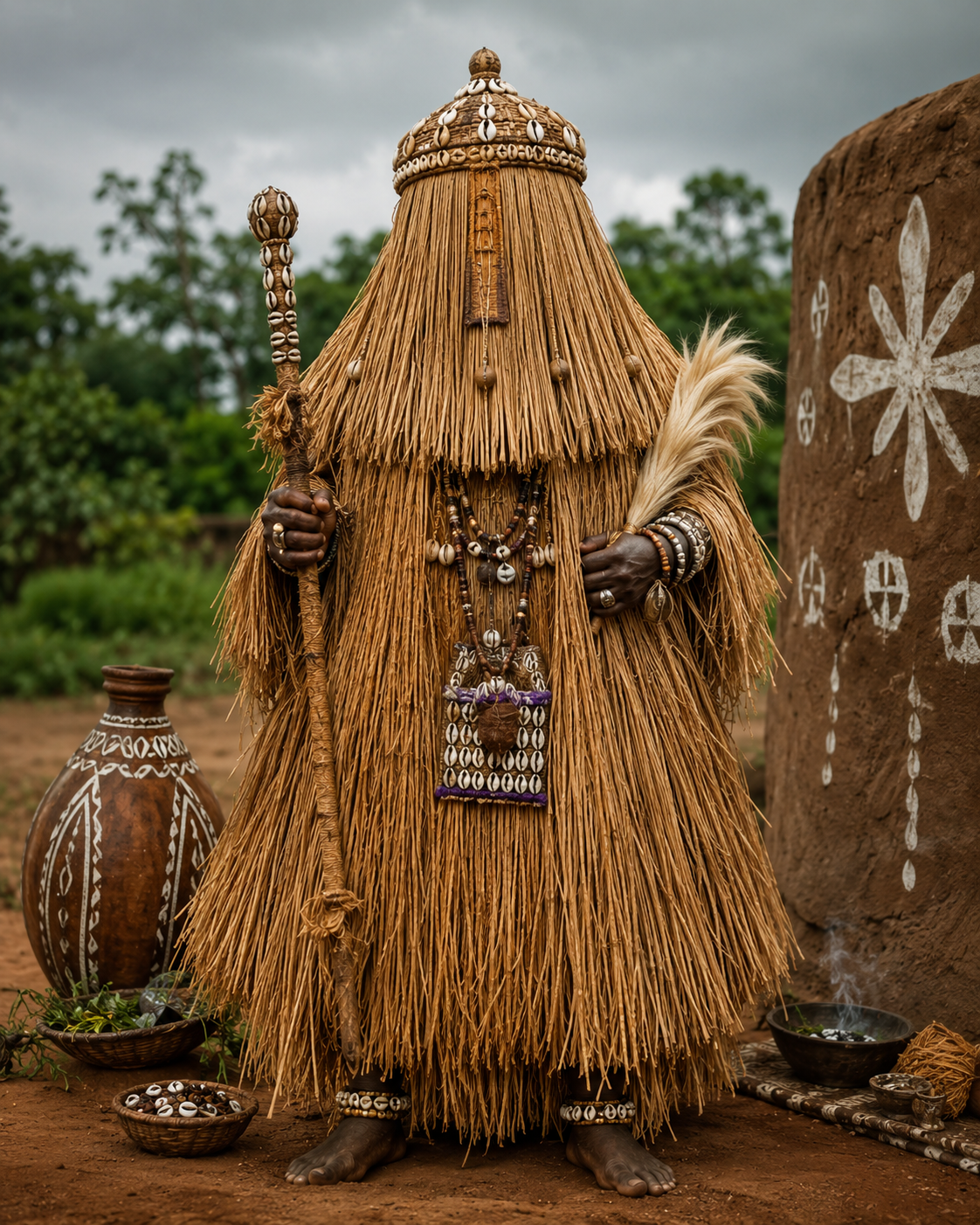
One of his most recognisable visual features — especially in African Diaspora representations — is a garment made from raffia or straw that can conceal much of the body. Interpretations vary, evoking disease, the hidden body, humility, the earth, and the mystery of the divine.

Raffia is a natural material drawn from vegetation, reinforcing his relationship with the earth. The garment does not resemble royal silk or polished metal; it communicates closeness to the ground and to natural materials, reinforcing his identity as Lord of the Earth.

Boundaries & Community Protection

Historical accounts describe Ṣọ̀pọ̀nná shrines at the edges or outskirts of communities. This had practical and symbolic significance: epidemic disease was dangerous to dense settlements, so the boundary between settlement and wilderness became meaningful. He is an Òrìṣà of boundaries as well as of disease and healing.

An epidemic affects families, neighbours, markets, schools, travellers, and burial practices — the entire social system. His tradition therefore carries a strong community dimension, posing a question that remains urgent today: how does a community protect its most vulnerable members?

Renewal & Resilience

Disease does not always end in death. People recover, communities rebuild, and the earth regenerates. His story contains the movement from affliction to healing, fear to understanding, suffering to recovery, and destruction to rebuilding — giving his tradition a profoundly hopeful dimension.

A community that survives an epidemic is not the same community it was before; it carries memory, scars, and lessons. The deeper question his tradition asks is not merely 'how do we avoid suffering?' but 'how do we rebuild after it?'

In the African Diaspora

The tradition travelled across the Atlantic with enslaved Africans. In Brazil, related traditions developed around Omolu and Obaluaiê; in Cuba and the Caribbean he became widely known as Babalú-Ayé. These traditions preserve important Yorùbá heritage while reflecting their own histories, and should not be treated as exact copies of contemporary Yorùbáland practice.

The name changed, the language changed, the political environment changed — but the essential cultural memory remained: the earth, illness, healing, vulnerability, protection, and renewal. This is African cultural resilience in action.

Join the Community

Preserving Heritage. Sharing Knowledge.

Receive new articles, festival stories, and cultural insights from ÀsÀNigHT Worldwide — delivered with care, rooted in authenticity.